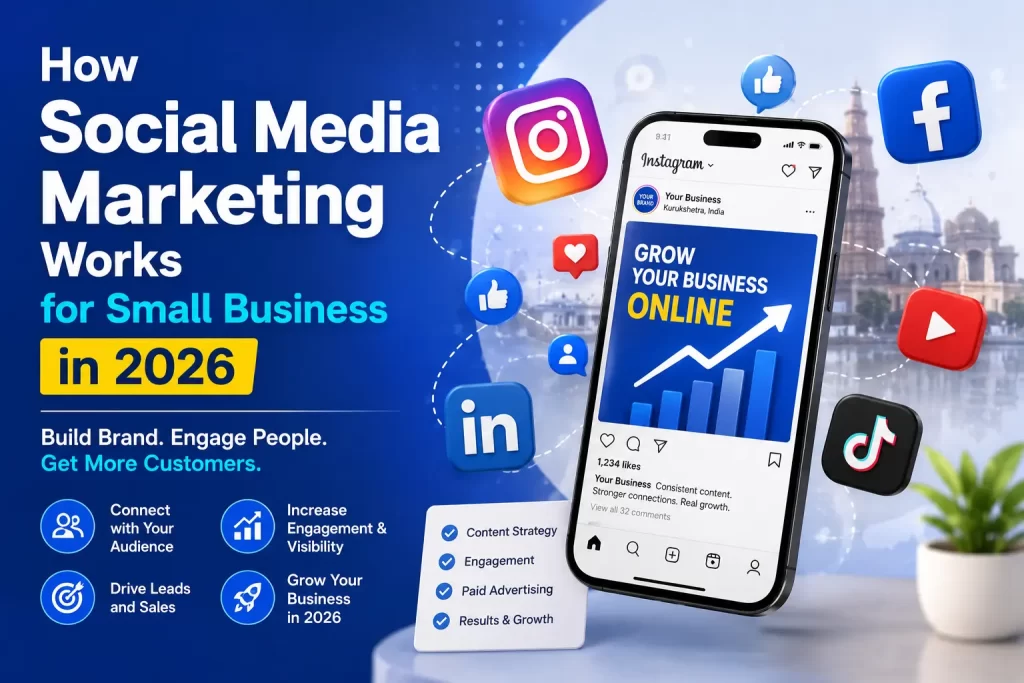
How Social Media Marketing Works for Small Business in 2026
A shop owner in Kurukshetra told me something recently. “I post on Instagram almost every day,” he said. “Nothing happens. No likes, no calls, nothing. I asked to see his last ten posts. Every one was a product photo. Same caption every time — “Available now, DM for price.” That’s most small business social media, honestly. Not broken. Just… not really trying their best because they don’t know how social media marketing works for small business. So here’s how social media marketing works for small business — not the version you’d read in a marketing textbook, but what I’ve actually watched work (and completely flop) for real businesses around Kurukshetra. If you’ve been wondering how social media marketing works for small business specifically, this is the honest version. What is Social Media Marketing? Strip away the buzzwords and it’s simple. You show up consistently where your customers already are, and you give them a reason to stop scrolling. That’s the whole job. Reels, hashtags, paid ads — all of that is just the “how.” The “what” never changes. Most people think social media marketing is posting whenever they remember. It’s not. Real social media marketing services start with a plan — who you’re actually talking to, what they care about, what you want them to do next. Indians spend over 2.5 hours a day on social media, on average. Not “online” in general. Social media specifically. Your customers are already there. The only real question is whether you show up with something worth their time, or just add to the noise they’re scrolling past anyway and get scrolled as everyone else or leave your business impact through it. A few things I’ve noticed matter more than people expect: People check you out before they call. Even someone who found you through Google or a friend’s recommendation will probably still peek at your Instagram first. If that page looks dead — no recent posts, old photos, nothing — you’ve lost a bit of trust before the conversation even starts. It’s cheap, if you do it right. You don’t need a huge budget. A page that’s actively managed, even without ads, can genuinely bring inquiries every month. Try getting that from a newspaper ad in Kurukshetra at the same price. You can talk to people directly. Comments, DMs, story replies — this kind of direct access didn’t really exist before social media. Most businesses ignore it. The ones who reply fast and actually engage tend to build real relationships out of it. Where to Actually Focus Your Time Instagram — Probably Where Most of Your Effort Should Go If you can only manage one platform properly, make it this one. Reels especially. I’ve seen a single decent reel outperform an entire month of regular posts — mostly because Instagram just pushes reels harder right now than anything else. The mistake I see constantly? Treating Instagram like a product catalog. Nobody’s excited to scroll through fifty photos of the same items. People want the process. The people. The “why” behind the business — not just another photo of what’s for sale. Facebook — Written Off Too Quickly People assume Facebook is “for older audiences” and dismiss it. But for local businesses in Kurukshetra, it still pulls weight — especially if your customers skew 30+, or you’re active in local Facebook groups. Ads on Facebook are also cheaper than most people assume, and the targeting is precise. LinkedIn — Only If You’re Selling to Businesses If you’re B2B, this one matters. If you run a salon or a food place, skip it entirely — your customers aren’t there for that. What I’ve Actually Seen Move the Needle Consistency wins over perfection, basically every time. I’ll take a business posting three okay things a week for six months over one perfect campaign followed by silence. The algorithm rewards showing up. So do people, honestly — they need to see you a handful of times before they trust you. Show your face. Or at least your team’s. People connect with people, not a logo. Businesses that put real faces on camera tend to outperform ones that only post products. Video isn’t optional anymore. I know static posts feel easier to make. But that’s not where the reach is. Even a rough 15-second phone video usually beats a polished graphic these days. Ads work — but only after there’s something to amplify. Running paid ads on weak content is like fueling a car with no wheels. Get the organic content right first. Then use social media advertising to push what’s already performing. Mistakes That Keep Showing Up Posting only when you remember. There’s no rhythm to it, so the algorithm never really trusts the account — and neither do the people following it. Talking about yourself too much. “We provide the best quality,” “we are the leading…” — nobody’s convinced by that. Show the actual work. Let people draw their own conclusion. Never checking the numbers. Every platform hands you the data for free and if you don’t check those analytics then you can’t improve and it will hard to make progress in social media marketing. No clear next step. A post with no call to action is a missed opportunity. Even something small like “DM to book” gives someone a reason to act instead of just scrolling past. After understanding these you have understand a lot about how social media marketing works for small business. So How Long Does This Actually Take? Depends entirely on consistency, if I’m honest. I’ve seen businesses land their first real inquiry within three or four weeks of posting steadily with reels in the mix. I’ve also seen businesses post for six straight months and hardly move, purely because they never adjusted based on what was actually working. A fair expectation, organically, is somewhere around six to eight weeks before you notice a real shift in your social media marketing results. Add paid social advertising into that, and it usually
How Social Media Marketing Works for Small Business in 2026 Read More »